Knee Pain
Cartilage wear and osteoarthritis, and what regenerative options offer at each stage.
Read more
For early to moderate knee degeneration, offered where the evidence supports it. If your knee is past the point where cells can help, you will be told before you travel.
Cells taken from your own bone marrow or fat tissue, prepared in the clinic, and placed into the knee under imaging guidance. That is the procedure. What it is for is a longer answer, and it is the part most pages skip.
A younger patient comes in with a cartilage defect. He plays football, not professionally, but enough that he wants back on the pitch. The MRI shows cartilage damage and some meniscal degeneration. His first question is almost always the same: can this regrow my cartilage?
This is where the treatment is most often misunderstood. At least with current technology, injections alone do not create a young knee again. In my opinion that should not even be the primary goal.
The goal is a knee that tolerates load again. Not a perfect knee. An adapting one.
The general procedure, and how the term "stem cell" is used and misused across clinics, is covered on the stem cell therapy page. This page stays with the knee.
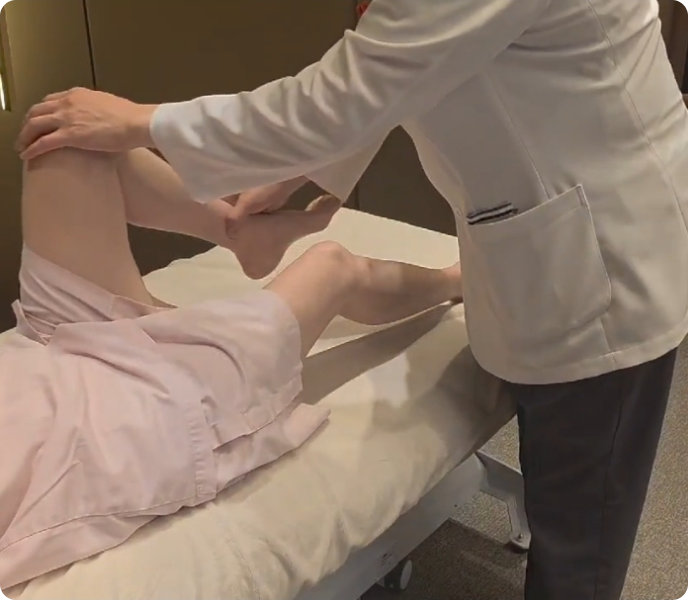
The painful knee is not simply damaged. It is usually a system that has been trying to survive under chronic stress, often for years, through compensation, altered loading, inflammatory regulation and muscular protection.
That is why two patients with almost identical scans function completely differently. One keeps exercising. The other develops chronic pain and a knee he no longer trusts. The difference is rarely the image. It is adaptive capacity.
So what the cells work on is the environment, not the architecture. Reducing inflammatory overload. Influencing cytokines and growth factors. Restoring load tolerance. Calming a protective response that has outlived its usefulness. Less like construction. More like biologic support for adaptation.
This also sets the honest ceiling. If the joint is still acutely irritable when we inject, even a well-prepared biologic often produces nothing meaningful, because the tissue is not in a state to receive it. In those knees we settle the joint first and treat second. We are not delaying treatment. We are sequencing it.
Knee osteoarthritis is the most common reason patients ask, but the stage matters more than the diagnosis. Cartilage defects, meniscal degeneration and partial tears, patellofemoral pain, and tendon problems around the knee are also assessed for it. Candidacy is decided after examination and imaging review, never from a list alone.
Cells are not the only option, and often not the first one. Where the problem is a tendon around the knee rather than the joint surface, Activated PRF is frequently the more appropriate treatment, and the full range of what we consider is set out under knee pain.
Cartilage wear and osteoarthritis, and what regenerative options offer at each stage.
Read moreTears with accompanying cartilage damage, where cell treatment is considered.
Read moreThis is the question worth asking before you book anything, so here is the plain version.
| Stage of the knee | What is realistic |
|---|---|
| Early degeneration, cartilage thinning, joint space largely preserved | The situation where cell treatment is most reasonable. Aim is pain, function and slowing the loss of load tolerance. |
| Moderate osteoarthritis, some joint space narrowing, symptoms not settling with rehabilitation | Still a reasonable candidate, with a more modest and more variable expectation. Rehabilitation is not optional here. |
| Focal cartilage defect after injury | Assessed case by case, often alongside the loading problem that caused it. |
| Advanced, bone-on-bone arthritis with deformity or instability | Cells do not rebuild a joint surface that is gone. We say so directly. The conversation here is about symptom management, or about replacement. |
One caution about staging, though, because it cuts both ways.
Some knees should hurt and do not. Severe osteoarthritis on X-ray, joint space narrowing, osteophytes, everything we are trained to look for, and the patient has minimal pain. The opposite is just as common: near-normal imaging, severe pain.
I once thought for a long time about an elderly farmer with a knee that looked near end-stage on film. Decades of labour. Repeated overload. The kind of image that makes clinicians say "replacement" out loud. And yet he kept working. Not perfectly. Not pain-free. But functionally, for years, without a new joint.
Structure alone does not determine biological capability. So the more useful question is not only how damaged the knee is, but how well the system is still adapting. Not every worn joint is a failed joint. This does not mean surgery is wrong, and for some patients a replacement is genuinely life-changing.
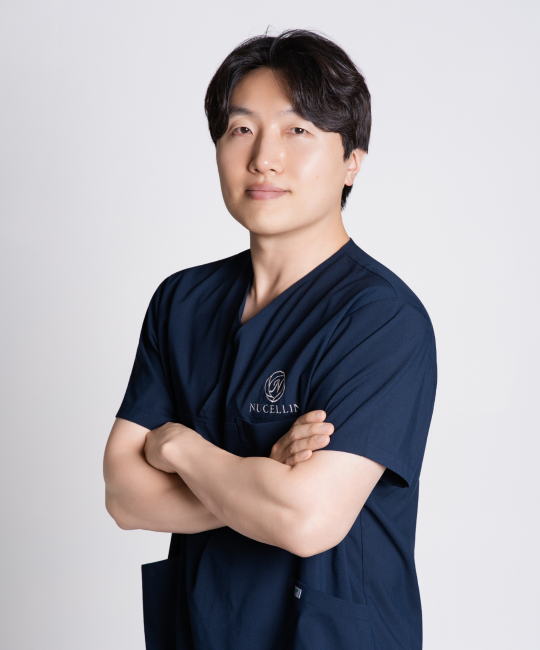
Your consultation is with the doctor who will perform the procedure, in English, without an interpreter in the room. Dr. Kim Hee-Jun trained in orthopedic surgery at Severance Hospital and previously worked there as a clinical professor of joint replacement, which is one reason the first conversation is usually about whether you need this at all.
Examination and imaging review with the doctor, in English.
Harvest and injection on the same day, under local anaesthetic. An outpatient visit, not an admission.
Reduced load and no high-impact activity until cleared. Soreness in the knee for several days is expected.
Review at around 6 weeks, 3 months and 6 months, remotely where that is clinically reasonable.
In weeks, because that is the honest unit. A quiet first fortnight is normal, not a failure.
Almost none of that timeline happens here. The part that requires you physically in Korea is short: assessment and imaging review, the procedure, and a check before you fly. We confirm the exact number of days your plan needs before you book flights, so you are not booking a month against a schedule that needs a few days.
The rest is done at home, with remote follow-up where it is clinically reasonable. Practical arrangements are on the international patients page.
Not every knee needs regeneration. Some need stabilisation, some need the daily loading pattern changed, and some need time and correct guidance. Escalating to a complex procedure too early tends to lower the overall result rather than raise it.
If you fall in the second column, we will tell you before you travel. That is cheaper for you to hear in an email than after a flight, and it is the reason we ask for your imaging first.
A first review costs nothing and commits you to nothing.